
In this episode, professional dancer and voiceover artist Elisa Toro Franky shares her transformative birth journey with a depth and poetic beauty that makes this conversation truly special. Originally from Bogotá, Colombia, Elisa brings her unique perspective as a performer to the birthing experience, drawing profound connections between dance and labor.
Elisa opens up about her conception journey, including navigating two early miscarriages with wisdom and grace, and how she reframed those experiences to move forward with hope rather than fear. She discusses the intersection of dance and pregnancy, how carrying Luna changed her movement practice, and the vital importance of listening to your body with the same attention dancers bring to their craft.
The heart of the episode explores Elisa's birth story—from declining induction twice while trusting her intuition, to her decision-making around accepting gentle interventions when she felt ready, to the powerful moment of a very quick pushing stage before meeting baby Luna. She shares candidly about finding her birth team at NYU Langone, working with doula Regina, and the great support of having her mother present from Colombia for over two months postpartum.
Throughout the conversation, Elisa weaves in themes of courage, intuition, surrender, and transformation. She speaks eloquently about "becoming the wave" during contractions, navigating the liminal space between her former and new identity, and the essential role of movement and cultural connection in her pregnancy and recovery journey.
This episode will resonate with anyone preparing for birth, especially those interested in the mind-body connection, the power of trusting your intuition, and the transformative nature of becoming a parent.
Resources:
Ferny - fertility clinic in Manhattan
Australian Bubs - goat milk formula
Sponsor links:
Free “Pack for Your Best Birth” Packing List (with free mini-course option)
East River Doula Collective (find a doula, attend our free “Meet the Doulas” event)
Birth Matters NYC Childbirth Education Classes (Astoria, Queens and virtual)
*Disclosure: Links on this page to products are affiliate links; I will receive a small commission on any products you purchase at no additional cost to you.
Episode Topics:
Elisa's background as a professional dancer from Bogotá, Colombia
Journey to New York City in 2008 with Dance Theater of Harlem
Current work with FJK Dance incorporating Middle Eastern, ballroom, and contemporary styles
The connection between dance and birth: dancers as "accurate listeners" of their bodies
Navigating two early miscarriages in 2023
Choosing an empowering narrative to move forward without prolonged grief
Working with Ferny (Fertility New York) clinic and Dr. Alia
Comprehensive fertility testing showing no concerns
Conceiving in 2024 during a creative period performing opera
Waiting three full moons (first trimester) before announcing the pregnancy
Choosing NYU Langone for integrated midwife and OB care
Finding doula Regina through East River Doula Collective
How pregnancy transformed dance practice: increased groundedness and flexibility
Discovering new movement qualities through carrying Luna's weight
Performing en pointe until December at eight months pregnant
Teaching throughout pregnancy to maintain vitality
Managing sciatica pain in the final weeks before birth
Catching a cold one week before giving birth
Declining induction twice while trusting the body's natural labor onset
The conversation with a trusted midwife that led to accepting gentle induction
Using cervical balloon and medication without needing Pitocin
Seeing familiar faces of loved ones reflected in birth team members
The Colombian midwife who spoke Spanish and provided cultural connection
Using vocalization, singing, and movement to cope with contractions
Adopting different positions including all fours with doula support
The concept of "becoming the wave" from the book Transformed by Birth
Mythological frameworks: Artemis, Persephone, and Inanna's journey to the underworld
Experiencing "labor land" - the liminal space between exhaustion and pain
Taking a low-dose epidural while still feeling fully present
The pushing stage: only 12 minutes with full awareness
Brief mention of forceps that ultimately weren't needed
The surreal moment of meeting Luna and questioning if it was real
Postpartum healing: two-centimeter tear with stitches
Continued sciatica and pelvic floor recovery
Establishing breastfeeding and managing initial discomfort
Luna's high feeding demand and supplementing with goat milk formula
Mother Consuelo's support from Colombia for two and a half months
Sleep rotation strategy: alternating nights with family support
Ancestral wisdom on baby care, routines, and distinguishing day from night
Raising Luna bilingually with emphasis on preserving Spanish
The importance of movement in postpartum recovery
Cultural loss when Latin American children don't learn Spanish
Final wisdom on courage, intuition, and trusting the body
Surrendering to the process rather than trying to control it
The transformative death of former identity and birth of new self
Open-mindedness in accepting that each birth journey is unique
Interview Transcript
Elisa: 00:00
You're listening to the Birth Matters Podcast, episode 137. And now giving birth was just a bigger, tremendous, transformative dance, but it was still a dance in the sense that your body would be talking to you all the time and you will be listening, yes? So that's why I find such profound compatibility between dance and giving birth.
Lisa: 00:40
I'm a childbirth educator, birth doula, and lactation counselor, and I've been passionately supporting growing families since 2009. This show is here to lessen your overwhelm on the journey into parenthood by equipping and encouraging you with current, best evidence info, and soulful interviews with parents and birth pros. Please keep in mind the information on this show is not intended as medical advice or to diagnose or treat any medical conditions. Have you subscribed to the show yet? Please be sure to do that wherever you're listening to this or over at birthmattershow.com so you don't miss out on anything. Today's guest is a professional dancer and voiceover artist, Elisa Toro Franki, who shares her birth story with poetic beauty. Originally from Bogota, Colombia, Elisa draws powerful connections between dance and labor, describing both as transformative journeys that require deep listening to your body. Elisa opens up about navigating early pregnancy losses with wisdom and grace, her decision to trust her intuition when declining induction, and ultimately welcoming baby Luna after a very quick pushing stage. She speaks about becoming the wave during contractions, the importance of courage and surrender, and how movement remained vital throughout her pregnancy and recovery. This conversation will resonate with anyone preparing for birth who values the mind-body connection and the transformative power of trusting your intuition. Elisa's perspective as a dancer brings a unique and inspiring lens to the birthing journey. Before we jump in, a couple of event updates. East River Doula Collective's next Meet the Doulas event will be on Tuesday, March 31st at 6.30 p.m. on Zoom. And our next virtual Savvy Birth 101 workshop will be on Wednesday, April 22nd at 7 p.m. on Zoom. You can find the link to sign up for either of these events on the top banner over at birthmattersnyc.com. So if you're expecting a baby or trying to conceive, we'd love to see you at either or both of those events. Also, our all-in-one childbirth class series are filling up really quickly for the fall, so if you're due in the next few months, be sure to grab your spot soon. And just a reminder that if you don't live in New York City or you just don't want to have to travel for childbirth class, we would love to have you join us for our live group interactive class series virtually on Zoom. A lot of folks have found this to be a very convenient option while still having the benefit of being able to chime in and ask questions in real time. This format is also priced lower than the in-person option, so it's a great option for folks with a more limited budget. You can check out this option as well as several other childbirth class options like private classes and our online on-demand course, all over at birthmattersnyc.com. Now, before you listen to our conversation, I'll share Elisa's recording of some written sentiments she had shared on social media that I had asked her to record. I thought it was so poetic and profound that we wanted to share it here for you to enjoy.
Elisa: 04:02
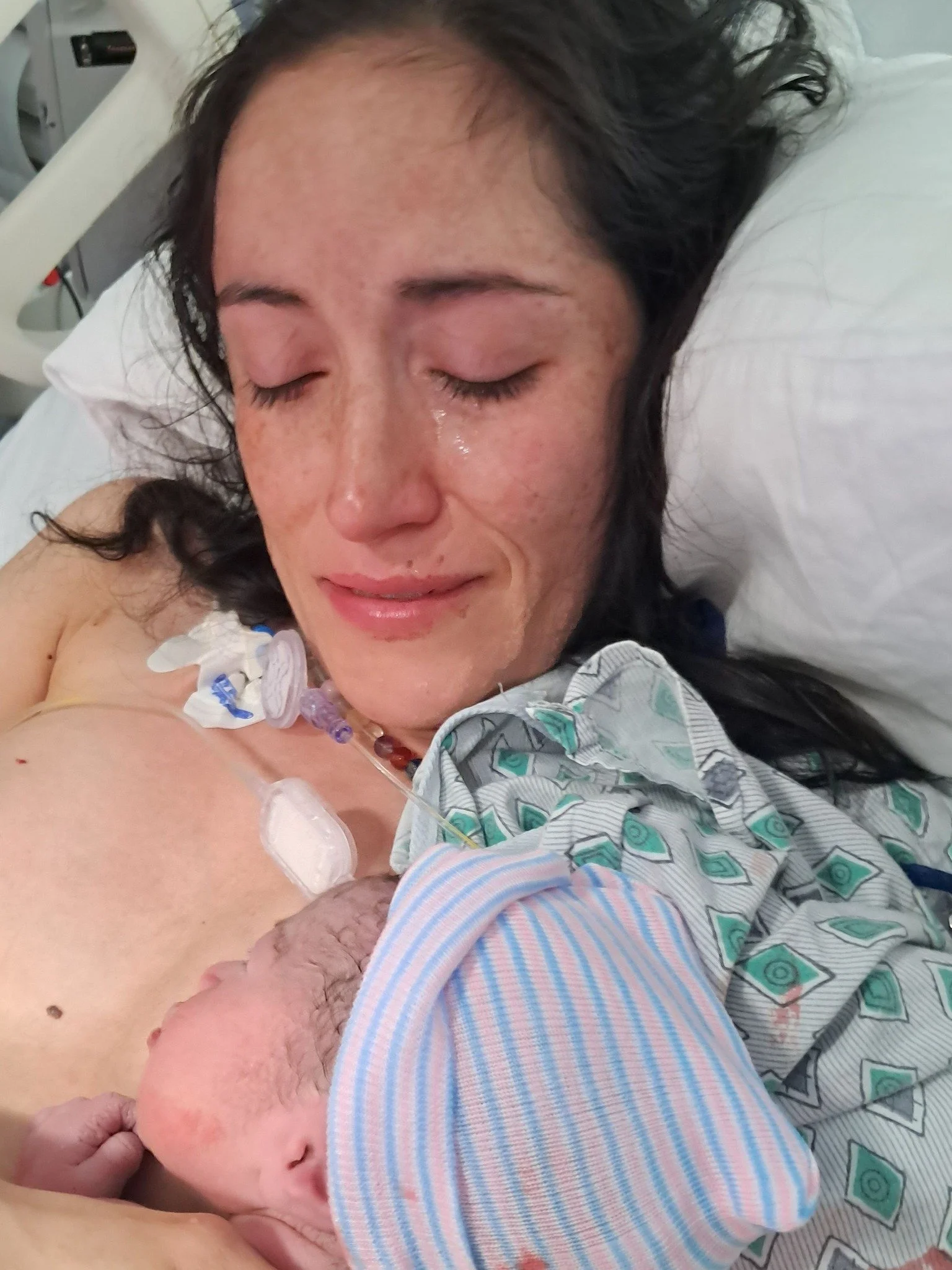
That is, if we were to use conventional denominations of time to refer to a passage when time dissolves, identity vanishes and is reborn. Channels previously unknown open wide, and darkness gradually yields to light. She is born and I feel in a liminal haze of being unsure whether this is a dream or real. She breastfeeds for the first time, while I quite literally see her enfolded in light. Her coming into light is a navigation via the oceans of the body, not the words, of the intuitive, not the conscious, of the non-calculated, unfathomable depths of the feminine. It is past midnight on February twenty-fifth, and I am in the initial stages of labor, feeling the gradual procession of waves that propel themselves more frequently and dynamically than I foresaw. My husband, Christian, and my mom, Consuelito, are with me. At the start, I am guided by a midwife whose features and genuine ways remind me of Mara, my dear friend. Hence I perceive the first channel as it opens. Mara's presence is felt in the room. Channels kept opening as more friends of mine seemed to enter the birth chamber in an archetypical way of revealing their presence through some of the birth professionals who assist me. The sense of humor and gait of one of the nurses remind me of Ida. The accent and warmth of another midwife resemble Francesco. And even the presence of my country, Colombia, is felt through another midwife, Colombian herself, with whom I speak in Spanish and in tears convey the joy of seeing her there. I follow the body's lead to cope with labor. The body asks for movement and mainly for the use of deep voice as the waves keep rising. At one moment I find myself placing one hand on my mom's shoulder and another hand on Christian, swinging from one foot to the other while both of them move in sync with me. I use the voice to open the gate for Luna to come forth. Singing happens, and with it my doula arrives on time to hold me through the most challenging sets of waves. She herself has an aura and radiance that makes me think of the moon, which is exactly my daughter's name, Luna. Waves keep growing to such amplitude that I wonder whether they would fit in me. Tears come in wishing for no more waves. Yet the Colombian midwife tells me not to resist labor, to let it happen to me, and to surrender to this transfiguration of identity that is meant to overtake me. As waves continue, I come to know that I simply am each and every single wave. No more, no less. Final stages, her head emerging. I am aware of a full entourage of women who know about the mysterious ways of birth. My husband being the only man in the room. Birth is indeed the art of women who all came to witness and care for those final efforts that carried Luna toward the light. It is 12:58 PM on February twenty fifth, and I have journeyed the internal, subconscious underworld of non-wakeful experience to finally see her face now lit by the midday sun. I nonetheless feel this moment of meeting Luna in such a surreal landscape that I can hardly believe I am now newborn myself. I am a mother. Christian's tears along with mine. His warmth and unwavering companionship makes him the father, whom I love eternally, and my mom's tears make her the grandmother, who is my most fundamental and timeless mentor. Never knew the real unbounded power of the feminine until now. The ineffable, profound force of nature that we carry as women by divine design. How timely that I write this during Women's Month, as it has never been more significant to know myself as part of this legendary feminine upon which life depends.
Lisa: 09:23
And now, without further ado, our informal chat. Today I have with me a former birth class student of mine, as is often the case, Elisa. Hi Elisa, how are you?
Elisa: 09:35
Hi, Lisa. It's wonderful to be here with you.
Lisa: 09:38
I'm honored. We are going to be sharing your written birth stories. When Elisa gave birth, I don't know how soon after it was, but you posted on social media your written birth story, and it was captivating. It was poetic, it was magical, it was ethereal. And so I immediately, I think it was that that prompted me to say, Hey, do you want to come on the podcast and share your story? And then once you agreed, I thought about it and I thought, hey, wait, she's a voiceover artist. I wonder if she would be open to pre-recording that version of the verse story. And then we more organically today will record a different version of it. So thank you so much for taking the time to write that out. It was so beautiful. I know it's going to be so inspiring to listeners. So honored to have you here with us today. Would you please just introduce yourself a little bit more?
Elisa: 10:38
Absolutely. Yeah, truly the honor is mine. And I am so happy that you were inspired by that story. It took two full weeks before I was able to articulate and write and put it out there because it was that profound, the experience that I said it really has to be captured in words. Or not just by any kind of word, but really what is the word that would come closer to the experience to describe it? My name is Elisa Toro Franchi. I am a professional dancer and voiceover artist. I'm based here in New York City where I had the pleasure of meeting you and finding you, Birth Matters, for this journey that truly has transformed. If we know anything about birth, it is that it is transformative. So finding you as a mentor was a cornerstone. Like it marks a before and after. It truly that you were that mentor that guided us through that passage that would lead us to a new version of ourselves, truly.
Lisa: 11:43
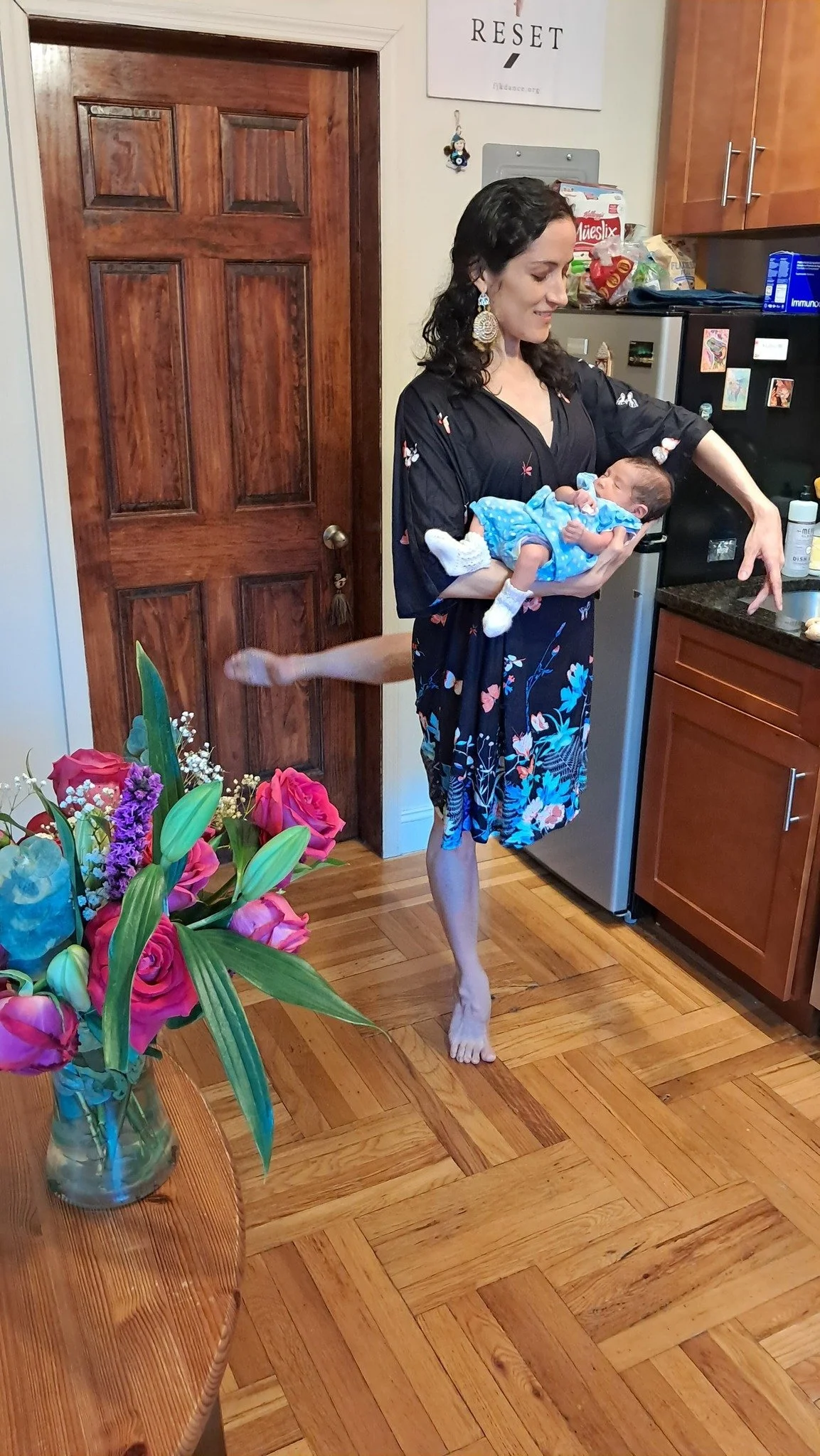
And before I forget, I just want to mention to listeners, Lisa is a gorgeous dancer. And maybe we can link to something that's on YouTube or something of your dancing in the show notes. I don't know. I'll have to check with you afterwards. But some of that you have this beautiful picture that will be, I believe, in the show notes of you holding your baby and in a ballet pose. I forget what the ballet move is called, but it was gorgeous. So gracious. It's an attitude, yes. I took ballet for nine years. How do I not remember these things? There you go. There you go. Gorgeous. And I hope I can see you perform live sometime. I'm eagerly waiting for that opportunity.
Elisa: 12:22
Will, I'm sure. Yeah, we will make that happen. We will make it happen when the time is right, for sure. Yeah. And did you mention yet what neighborhood you live in and how long ago you gave birth? I live in Washington Heights. Um, and this, yeah, I live in Washington Heights. I have been living here for actually 10 years already. And I gave birth on February 25th of 2025. Wow, what a date. Yes.
Lisa: 12:49
Beautiful. You're right at that fourth trimester, exiting the fourth trimester. Three months. That's where we are. As of the time of this recording, it'll air later, of course. Three, she turned three months. Exactly.
Elisa: 13:01
There you go. Yeah, exactly. That's where we are. That's where we are.
Lisa: 13:05
Exciting times. And I got to see you and meet little Luna at the reunion very recently. So that was such a joy. And got to see and hug you, Christian, as well.
Elisa: 13:15
We love to see you. It was such a joyful reunion with all the parents and the babies. It almost felt like we had made it to shore after such a navigation. We all met again on firm land. We made it to shore. And we were so joyful. Honestly, it felt like that. Oh my gosh, we made it to the other side. We are on the other side, and you were there. As I said, you became a cornerstone, like a cornerstone or mentor, somebody who really guided us. And in a way, seeing everybody with the babies, you all the babies and sharing all the experiences, it was truly magical. Because yes, we met before, but we are meeting each other for the first time. Like we are new. We know that this is a new life for all of us. And we know that.
Lisa: 14:09
Elisa, you just made my heart sing in using continuing the water metaphor that we started with in class. You just said we made it too short. I was like, oh my gosh, that's a continuation of the water metaphor.
Elisa: 14:22
It truly is. I believe it. Yes. Beautiful.
Lisa: 14:27
All right. Well, anything else you'd like to share about yourself in terms of your introduction before you go ahead and share with us anything about your conception and pregnancy journey.
Elisa: 14:38
I would love to share also that I am from Colombia. I am originally from Bogota, Colombia and I came to New York City so many years ago. I came in 2008 because dance is the reason why I came. I came to the United States to pursue dance professionally. And my first job with the company was with the Dance Theater of Harlem Ensemble back in 2008. And the legendary Arthur Mitchell, founder of DTH, he was the one who hired me at that moment. And I will be forever grateful because it was because of him that I was able to come to New York. So dancing with DTH, Dance Theater of Harlem, and then New Jersey ballet as well. And now currently with several smaller companies in New York, but especially with the FJK dance, where we have that beautiful Middle Eastern component and ballroom, visual arts, contemporary dance, and of course classical ballet, all of it coming together into a whole. So yeah, the reason I'm sharing about dance is because dance was a major source of vitality throughout my pregnancy and throughout my recovery. And in a way, like giving birth and being a dancer are quite compatible in a way because dancers are accurate listeners of their bodies. Like we pay such close attention to our body. We listen to everything that is going on with the body. We listen to the language of the body. We listen to what the body has to say at all times because of the nature of dance. And now giving birth was just a bigger, tremendous, transformative dance, but it was still a dance in the sense that your body would be talking to you all the time and you will be listening. Yes. So that's why I find such profound compatibility between dance and giving birth. Yeah, that's something else I wanted to share before we go on.
Lisa: 16:37
I love that. Accurate listeners of the body. I love your wording of that. Yeah, it's great. I do always love having dancers in my classes because of their bodily, their accurate listening. I say bodily awareness, but I like your terminology better. Yeah. There's just feeling so intuitively moved toward movement. Just instinctively wanting to move and finding that to be a language in and of itself helps labor to help the birthing process to go more efficiently and healthfully.
Elisa: 17:15
Yeah, which I find very fascinating that the minute you started sharing with us about the positions that we could use, the motion that we could use to cope with labor, so much of it, so many of the positions are like dance positions. I'm like, oh my gosh, we do this on a daily basis. How wonderful that somehow preparing for birth or some of it is already embedded in the dance practice. So there's a lot to say about the intersection between dance and preparation for birth, I feel.
unknown: 17:52
Yeah.
Lisa: 17:53
Absolutely. I love it. And just going back to what you were sharing about your professional background and the kinds of pieces of art you collaborate with others on, I just so love the intersection and the weaving together of different cultural traditions and dance. I think I just think that there's such beauty in that because we need more of that. We need more of the unifying and less of the division in our culture.
Elisa: 18:20
Oh my God. Yeah. Especially, for example, the company that I keep on mentioning, FJK Dance, the director, those are the initials of the director, Fadi Huri. He was born in Iraq. He grew up between Iraq, Lebanon, and Syria. And he brings that Middle Eastern voice, especially nowadays. Especially. So he is somebody who wants to have that beauty and that legacy integrated with other dance vocabularies and to have different cultures together, dancers of different backgrounds. Actually, this year for the production, we have a piece that includes some voice recording of Rumi poetry, the Persian poet Rumi. And he asked me to translate it into Spanish so that I could record part of it in Spanish. And my Japanese friend, my fellow dancer, she's amazing, Manatsu, she recorded in Japanese, and Fadi himself recorded in Arabic. And you're gonna hear those voices. So speaking of multiculturality, like multiculturalism, there we go. And especially as you said, now more than ever, that is important. We need space for that to be expressed and valued.
Lisa: 19:30
Yeah. And to get us out of our thinking brains and into the poetic, the artistic, the dance, all of that is so powerful. Because that's where we can change minds and change hearts, is when we get out of that thinking brain. Yeah.
Elisa: 19:45
Out of the thinking brain and into a space where differences can be in harmony, like different cultures being in harmony and being able to dance together. Oh my god, tell me about it. If the world could do that, different cultures in conflict could find a way to coexist in harmony. Anyways, we can talk about that.
Lisa: 20:04
But yes, a whole separate podcast. Yes.
Elisa: 20:10
Totally.
Lisa: 20:12
Thank you for that important, beautiful work you're doing. All right, so would you like to use that now as a springboard into talking about your conception or pregnancy journey?
Elisa: 20:25
Absolutely. Yes. Okay, what was my conception journey? We started uh actively trying to conceive in two 2023. Yeah, 2023 was the year when we said we're ready to have a child. Let's go. So that year came with I got pregnant twice, but then I had a natural uh yeah, like basic basically I had a spontaneous miscarriage twice. And of course we did our research and we learned that of course the statistics of it are very high. Like one in four women would naturally miscarry. Yes, so we didn't get concerned. Of course, it can be challenging for any prospective mother and father to see that happening. But at the same time, we understood the laws of nature and we also understood that maybe it really was not the time. Yeah, we believed that when a new soul is ready to come, it is ready to come. But if it's not yet ready to come, then maybe it's not the time. So we were able to just go with the flow of it one more time. If my body somehow recognized that the baby was not growing, then it let it go. So we understood that in the moment and we just accepted it and we actively let go of those two possibilities without major, without giving it additional narrative or meaning, like attaching ourselves to that. No, we accepted it and we kept on going. For us, it was very important to see us moving forward without wasting time. We didn't want to be like, oh my gosh, maybe something's wrong. Let's know. We were able to move forward and see that as natural processes of life. Like nature has its own ways. And we kept on trying. We didn't wait to try again. And of course, that happened in the early gestational age, yeah, a few weeks only. So we had time to readjust. And since it was that young, the idea of, oh, we conceived, maybe this is going forward. But let's wait, let's see. In the early gestational age, this is very likely to happen, then this happened, then we let it go. We took a moment and then we tried again as soon as my cycle came back to normal. But nonetheless, we visited the fertility clinic, a very beautiful place. It's called Ferny New York, Ferny, so that stands for Fertility New York. And I ran into this place on my way to rehearsals down at Chamber Street. And I said, Well, I could just stop by and see if maybe they take my insurance, maybe I can have a conversation with them. And they were absolutely wonderful, especially a doctor there, Dr. Ahluwalia. She was particularly kind and invested in my case. And she said, Okay, let's do all the checkups, let's do all the examinations and see to see what if there is anything to be concerned about. And nothing was there to be concerned about. All the exams came out just fine. So that only reinforced the idea that a natural miscarriage, it's a natural thing to happen. There shouldn't be a stigma about it, actually. And I'm hoping people won't be as discouraged because there's no reason not to try again, no reason to let yourself get I hopefully if you avoid being hooked in that grief, then you can take that time to try again as opposed to waiting too long to try it again. So, anyways, once all the exams came out just fine, then we just kept on trying, and then 2024 came. When I was not expecting it, when I was in the midst of performances of a very creative face of the year 2024, I was performing with an opera ensemble and I had an acting role, not only a dancing role, but an acting role. I got to speak a few lines, and even that the seven deadly sins, I had such a fantastic experience performing a leading role with them. In that month, I conceived somehow the creative energies or just you opening, opening yourself, like how do you say, performing in a different way than I'm used to, somehow perhaps opened some energy channels in me and made me grow more in the world. That's the word that comes to mind.
Lisa: 25:08
Which one? Yeah, no, growth like artistically, and then growth physically inside of you.
Elisa: 25:15
Exactly. So somehow I was growing or being stretched artistically, and in that moment, when I was not truly expecting it, yes, we were conscious of the fertility dates, but and yes, we were trying on those dates, but not too stressfully, not putting too much mind onto it, just really being as present as we could be in every moment. And that somehow made me more receptive to the conception happening. And then this time we said we're not gonna rush to conclusions, we're not gonna rush to excitement. We are gonna take our time before we even accept that this is real because of our previous experiences in those previous conceptions. We rushed to the excitement too early. As I said, early gestational age. You still have to take your time before it is confirmed that this is moving forward. I think this is wise for us to be aware of that. And then this time when I conceived again, we said, let's take it one day at a time, let's do the test. Yes, the test is positive, so let's continue to take it one day at a time. Being as neutral as possible, stoic almost about it. Be uh stoic so that you don't rush to an excitement before it's time. And I said, I'm gonna wait for three moons, three full moons, the three first months. I'm gonna wait for three full moons before I allow myself to say, yes, this is happening, yes, I'm being excited now, yes, I'm gonna tell my family. I said I'm gonna stay quiet with Christian, with Christian and Christian and I said we're gonna be quiet and absolutely calm until those three moons come. And then we'll see. But we're taking one day at a time, and one day at a time was one day, every day the pregnancy stayed, every day it continued every day. That was a day to be grateful. I'm grateful because it's continuing day after day, after day, and then that's how we hit the third moon. And as soon as that third moon came, we told our parents. Yeah. Then now she was ready, and her name is Luna, her name is moon. Oh yeah. I waited for the moons, yeah. Uh-huh.
Lisa: 27:51
Beautiful. So then anything, what are the different ways that you prepared in pregnancy for becoming a parent? And or any medical things to note? How did you choose your birth team? Any of those things? Oh, okay, yes.
Elisa: 28:08
That so as soon as okay, as soon as we tested positive, we went back to Fernie to the fertility clinic, and they checked on everything and they said let's be cautiously optimistic. And as soon as they saw that everything was happening, it was going well, they also said it would be wise for you to take some progesterone to just be extra sure that this is gonna stay, that the pregnancy will continue. And once we saw that yes, it was continuing, and actually my body was producing the progesterone that was needed, they said, now it's time for you to find an OB. Yeah, obstetrician. I said, sure. So it took some research. It took some research for me, like it was through my initially it was through my primary care doctor that I found NYU Langone. They said, they suggested it, would you since you know we're talking about pregnancy, would you like to be with NYU Langone in Columbia? I think it's the yeah, NYU Langone. So I know it's a really big system. And then we followed the lead of my insurance, I needed this to be covered by my insurance. Yeah, I think that's very important. So I went, I called, I contacted them, and I made sure that they would be taking my insurance. And of course, as soon as you're pregnant, then things change and you know you can you're eligible for Medicaid and all of that. So as soon as I found out that NYU Langone was taking my insurance, I said I'm going with them. And the more I went into that system, I started, I scheduled an appointment with them. They see you when you're like six 16 weeks, not before. But the minute they started seeing me, I started gathering references from people. Like they are very good. NYU Langone, they're very mindful. They work with midwives, they actually you're in very good hands. The minute I met my doula, whom I would love to talk about later, she said, NYU Langone, yes, you are in very good hands. They are making good conscious efforts as far as creating a bridge between OBs and doulas and midwives. And they were the first to say, Are you working with a doula? Actually, yeah, maybe the first was a friend of mine, but they were also among the first to ask, Would you like to work with a doula? It is advised to work with a doula. Yeah, they have midwives there and OBs. So that integration and that communication, that conversation between different specialties is absolutely promising. It really was helpful for us. Totally.
Lisa: 30:52
And did you end up working with the midwives exclusively?
Elisa: 30:57
Not exclusively. With them, mostly with them, yes. For the regular checkups, I would be seen by different people. Maybe I was seen more often by a midwife who truly inspired my trust. Like I, I came to trust her in a very important way. And I do mention her in the story that I published. But she's a midwife. But then also for some of the visits, I saw obstetricians. And it is a back and forth between them. But I feel like if you ask me, more often than not, I would be seen by a midwife. And then, of course, they have the nurses and they have the people who are in charge of the imaging, the sonogram, and all of that. So they have such an incredible team, big system. They truly make their best efforts to take care of you from different angles, from different specialties. Highly recommended NYU Langone. Absolutely.
Lisa: 31:53
Nice. And at what point? So it sounds like fairly early on, or at some point with NYU, they were recommending that you work with a doula. What do you remember around what time in your pregnancy you decided to start interviewing and pursuing a doula?
Elisa: 32:10
Absolutely. The second trimester. It was the second trimester when a friend of mine, also a dancer, she got on the phone with me. She wanted to advise me because I was seeking her advice. She already has two kids and she continues to dance professionally. We have danced together. So we are co-workers, and so I said, Hey, motherhood and dance, please advise me. So she advised me and she said, Listen, the best investment you can do is a doula. You have to. It's worth everything. Yes, all the effort. Yeah, you work with one, you interview them in your second trimester, and then she makes all the difference in your journey. Truly. So it was because of her that I ended up finding you, actually, Lisa, because she said she had a doula herself, but then when I asked her, would you recommend me? Would you connect me with your doula? Maybe I can work with her. She said, I totally would, but she's retired. However, I can just message her and ask her if she has any other recommendations. So it was her former doula who said you should get in touch with East River Doula Collective. And I said, sure, I'm gonna look them up immediately. And this is how I came to know you. I came to discover your work, both as a leader of doula and also as a mentor for expectant parents, right? So we said, yeah, the birth preparation course with you, of course. And then when I wrote you the first time asking you for recommendations, I need to meet at Doula. I really wanted to start interviewing Doulas. And it was you who came with the resources. So I'm so grateful. I'm so grateful.
Lisa: 33:46
And you ended up hiring Regina, is that right? For your doula?
Elisa: 33:50
Yes. And yeah, I mean, she like the first moment I see her, the first moment I see her is the moment I know I'm going with her. Because my intuition told me immediately, like, she is the person I'm gonna work with. The quality of her listening, the quality of her perception of your particular case, your particular needs. It's unparalleled. I immediately felt seen and heard. I felt open and comfortable completely. I felt like she like water, Regina was like water, she adapted completely to my own particular case, and she offered nothing but wisdom and guidance. I felt just safe. I felt like I had a companion, I had somebody I could trust and somebody who would take me by the hand and help me navigate those waters that I never knew, that were completely unknown to me. Regina, yes, I would recommend anybody to work with her.
Lisa: 34:59
I hadn't really thought about it intentionally until now, but as you were talking and sharing about her, both of you strike me as particularly intuitive individuals. And so in that way you were so well aligned.
Elisa: 35:14
Completely. Interesting, Regina. The first time I met her, she came to a performance of mine when I was six months pregnant. And it was before me. And Regina came and I said, We're so sweet of you to come to the performance. And then that's when we got to serious work right after the six-month mark. She, yeah, that's when we started scheduling all our meetings and everything. But yes, Regina and I are both intuitive and we uh somehow we connected like perfectly from the beginning.
Lisa: 35:46
Nice. So nice. Love it. Wonderful. Were there any other things you wanted to share about your pregnancy before you go on into your birth story?
Elisa: 35:56
Yeah, oh no, actually, I feel like it's very important to choose your narrative. Yes? So when we had those natural miscarriages, we chose a narrative that was empowering, that would allow us to move forward and not waste valuable time also because I'm 38. It's not like I had a whole lot of time. There are different times for conception, and women who are older than me can conceive not a problem. But at the same time, for me, I said I really would love for this to happen soon. I don't have any time to waste in grief. I really want to be able to move forward. So if I want that, how can I help my own narrative and the meaning that I attach to everything? The narrative, I wanted to be someone that helps me move forward. And that's how, yeah, like when we conceived a Luna, still it was remarkable like the calm with which we waited for the third month and for the all the results of all the examinations, the genetic tests and everything. We waited for everything with serenity until we had all the results. And then as soon as we saw that, hey, this time this is happening, this little soul is really ready to come and she's coming healthy. That's when we started oh opening the doors for all the joy, opening the doors for everything that was to come. Let's m look more closely into the doula. Let's, you know, as I said, and why you langone won't see you until you are like further along in your pregnancy. Yeah, they're gonna see you when you have greater chances of this moving forward, yes. Not so early, they're not gonna see you too early. And then that's when we started like envisioning, okay, so timeline, and when is she gonna be born? And how can we start like thinking of setting, resetting the apartment? But obviously that's gonna come later, but it's so many things to get ready, so many things to prepare. But mostly it was an act of getting my body into a place of yes, I'm ready for this transformation, yes, I'm ready to change whatever I need to change so that I can give light to this new life. And for me as a dancer, being all my life using my instrument, using my body as my instrument, that's a challenging task because you're gonna see your instrument dramatically transforming itself so that new life can come, and then you're gonna recover. But being prepared and open and willing to give way from that transformation, that took me years to be prepared. It took me years to say absolutely yes to this. And once she was here to stay, once the pregnancy was for sure to continue to move forward, I started seeing my body changing and it took an effort, or I needed to be mindful, I needed to be also to tune into my spirituality to allow that change and not resist the change. Let it be. Don't worry about it. If you're not jumping anymore because you need to be safe, that's okay. You'll jump again later. It's a temporary situation that you're letting your body transform the day of the day. It took some courage, but we made it happen. Yes. So, yeah, that's what I can say. Like accepting the change and going with it without resistance, basically.
Lisa: 39:30
That's such wisdom because there is so much body image stuff that comes along with this journey. And I would think, like you're saying, especially for a dancer where that's your instrument. Yeah, yeah, that's really wise. Thank you for sharing that. One point of curiosity I have going back to your family origins in Colombia. This is a difficult topic, the topic of loss and grief and death. I was curious if there are any cultural differences that were helpful to you in that, or was it just a personality thing? Because in the US here, I feel like we have such an immense fear of death, but not all cultures do. I'm just interested to know if you have any reflections on that piece of it.
Elisa: 40:17
Oh, okay. The fear. You mean fear of death as approaching the moment of giving birth? Is that what you refer to?
Lisa: 40:28
Oh no, I was thinking about your loss, the pregnancy losses, the early pregnant miscarriages.
Elisa: 40:34
Yeah, there could be it can be tricky because how do I put this? I feel like there could be some stigma around the fact that, oh, you had a loss. Oh, you had a second loss. Maybe there's something wrong with you. Not necessarily. Sure. As I said, it is truly the loss of nature and the statistics are high. And when the body recognizes that there's something not quite working, and it's not the moment to grow, like the baby's not growing, then the body releases it from its own wisdom. There's something wrong. I'm releasing, I'm releasing. So I think it is we we should cherish and treasure the wisdom of the body because you the body can recognize and can let it go. So if you surrender to that and say, sure, I'm gonna help you let it go and I'm gonna trust the process, I think that's beautiful. That's wise. There shouldn't be a stigma as far as the fact that there was a loss. So the first time, yeah, the first time it was like a lighter experience. It came, it happened sooner after conception, it happened sooner. The second time, for one reason I told my mom, and I told my mom that we had conceived, and she was cautiously optimistic. She started getting excited, and she was helping me and supporting me and sharing resources with me. But of course, when the loss came, when the loss came and I had to tell her, she was a little bit sad, of course. And not yeah, not only her, but perhaps another friend with whom I spoke. She went into that place of sadness a little bit and I said, I actually don't want you to be sad because I want you to take this as something normal, natural that can happen to anybody. And I would love for you to just be as ready as I am to try it again without delaying. And I feel like in Colombia, yeah, maybe there could be a stigma when it comes to being able to have a child or not. And I feel like this is something we need to open our minds as far as the diversity in journeys. Like people can have different journeys, different timings. There are different ways to be a mom. And also there are different times to be a mom. So the more we can open up, and also it's wonderful if you decide not to have kids too. Like it is to be respected, the journey of each woman, however it is that the woman chooses for that journey to be. So the more open-minded we can be, the better. And I feel like for us in Colombia, still there is that tendency to have one version of how things should go as far as having a family. It depends on the region of the country. Some regions are much more conservative, and I feel like open-mindedness is increasingly important. I had to say it is increasingly more and more necessary and important for women to feel more free, to feel empowered, and to feel like they have room to be in any way that they can be, and to follow their journeys in any way that they choose to, without fear of being disapproved. Or being like we don't need any pity if you have a natural loss. You do not necessarily not asking for a for pity or for somebody to be sad about you. Maybe something important is to have somebody who would help you feel empowered and fresh to move forward and to try it again if that's what you want. At least that's how I felt.
Lisa: 44:22
Yeah, yeah. Thank you so much for sharing that perspective. Appreciate that. All right. So what next? Would you like to go into your birth story or the last few weeks or days of your pregnancy? Sure, absolutely.
Elisa: 44:41
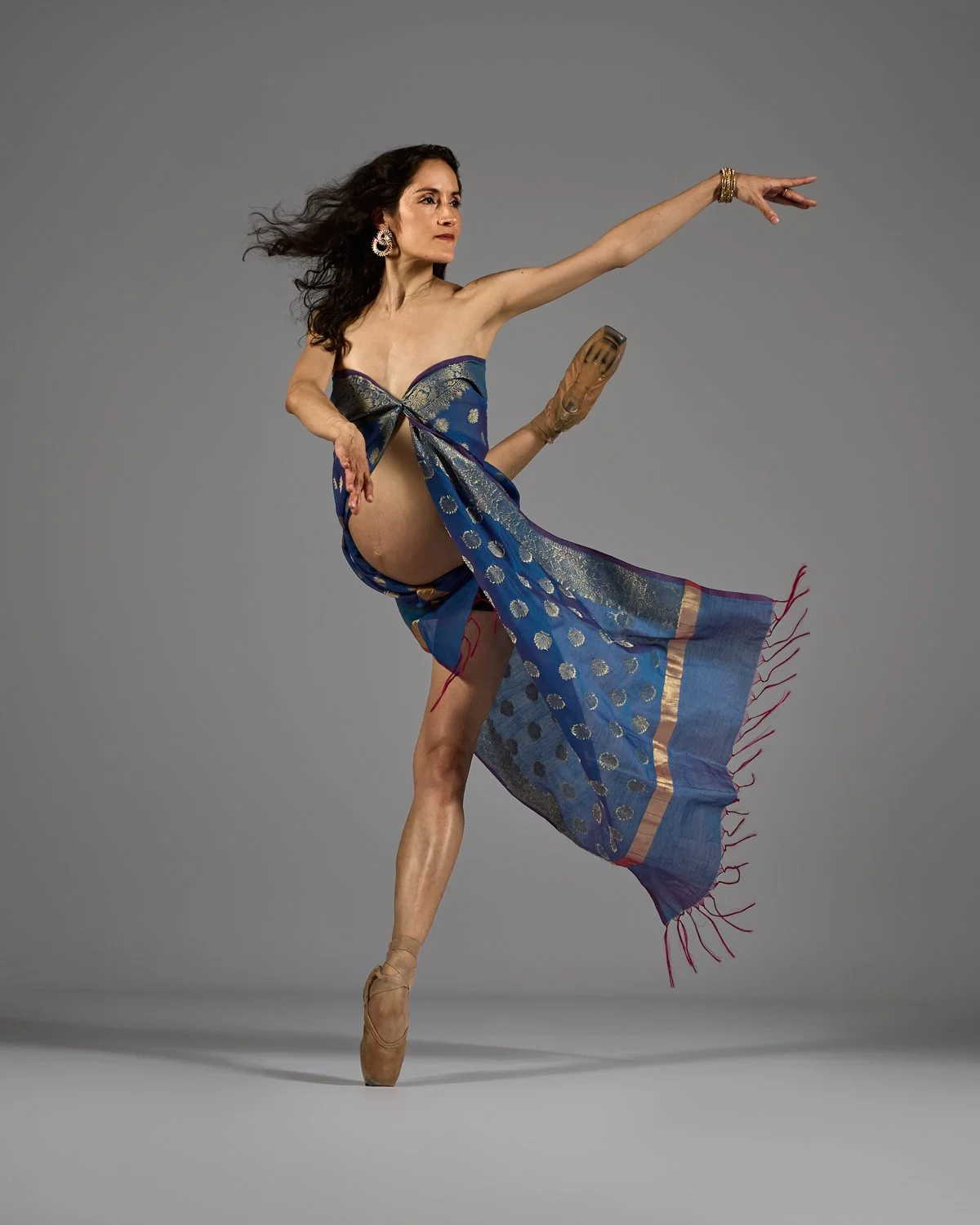
Okay, so let's see. Yes, so Luna was growing, visibly growing. I started to feel her. I started to feel her kicks. I started to feel her more and more in me as I danced. And I felt, as a dancer, I felt more grounded than ever since she was growing. Then I felt like my weight could really feel like it was really landing on the ground. I felt my weight for the first time truly landing on the ground as opposed to being too vertical, too light. I felt, oh, now I can really tune into horizontal ways of dance, like anything tango, for example, for example, or flamingo or Latin American dances, where you really need the weight and you need the movement of the hips and everything, even what we work on with the Fadi, my director from Iraq, the Middle Eastern movements and the movement of the hips, especially, everything came much more like natural and organic, feeling the weight of Luna. So I said, okay, I can really enjoy this, I can really tune into this and learn from the experience of my body carrying her and carrying her into the movement. Yeah, how is her presence impacting my movement? Yes, I'm no longer able to jump, my body is not leaving the floor, but what else can I delight in? Yes, as far as having that extra weight of her growing within me. So I kept on dancing the whole pregnancy. The whole pregnancy. She was due at the end of February, and I was still dancing on point. December 1st. On December 1st, I had my last performance on point before I said I'm not doing any more point work until she's born, except for the photo shoot that we did in early January. We did a photo shoot on point. But of course it's different to just take a pose rather than performing on point. But then I kept on actively moving with Fadi, with my director of FJK Dance. And also in my teaching, I held on to my teaching so strongly because it kept me vital, getting up, getting myself ready, preparing myself to go and teach and demonstrating everything I could demonstrate still being pregnant, moving with my students, feeling the weight of my body. It helped me keep that emotional vitality that it could be compromised in pregnancy. Yes, our emotions really fluctuate in pregnancy. So the movement and what movement does to your body, I feel it's closely connected to your emotional vitality. I want to call it vitality because this is how I felt every time I moved. It boosted my energy, yes? Yeah, it sparked my energy just to be able to move and to still be able to teach and stay active. Of course, there were certain aspects of movement that I had to be much more careful about, but I still was able to move, and even flexibility improved with pregnancy. So many wonderful things were happening with my body, different nuances of movement and sensation I was feeling as the pregnancy progressed. And I felt there's so much that I need to be listening to right now, as far as my body is telling me. And then, so six months, I was still feeling like no problem, no restriction in movement, really, not much. And then by the time I performed in December, I was coming to eight months. I kept on feeling just fine, quite honestly. But then when Luna turned head down, that's when the pressure increased a lot. Uh-oh. In the pelvic area, that's when the pressure so I said, okay, so here's the moment to be even more careful. I felt I could feel her. She was already head down, and that's when I started feeling, okay, I need to walk more slowly. Yeah, I would notice that my pace of walking was slower. I'm like, I'm a fast walker, but I need to give up on that. I need to walk slower. It's gonna take me longer to get from place to place. That's fine. Because I was feeling her pressure, the pressure of her head being down. And then it was not only, how do you say, not until two maximum three weeks before giving birth? That's when I really started feeling like the sciatica pain on my right side. Oh that was that was the moment when I said, Oh, okay, now I am dealing with discomfort. Now I um I need to just continue to do the stretching that I can, like the strengthening that I can that is safe so that I can help my sciatica. Because yes, I started feeling that strongly for the last few weeks. But even in those last few weeks, I was called to assist a rehearsal with another company with accent dance to coach the dancers. Of course I could no longer like dance with them, really, but I could still be in the room with them and stretch a little bit and coach them and dance through them. I felt like I was dancing through them.
Lisa: 50:05
Perfect. And interesting. Maybe not perfect, but nice to at least have that channel.
Elisa: 50:14
Interestingly, yeah. Interestingly enough, I felt like in that moment, new waves of wisdom came to me as I was coaching them and telling them about their theatrical expression and how their mindset would really show in their movement. And just by not dancing, I was able to understand a lot more about the piece we were working on just because I was at the outset. And somehow I was scaring Luna and the presence of Luna and knowing that she could be born anytime that month in February. I was in rehearsal and it could happen anytime. It made me so present in the moment, and I felt it made me wiser in how I would like give everything I had, give all the wisdom I had in that moment available to the dancers in a way that was like releasing. Yes. I almost felt like I was coming to the end of my former identity, like my former identity was about to be, I want to say vanished. So I was coming to the end of my time as I knew my former self. So in that coming to the end, you just release some wisdom, some love, some waves of vision that are there in that moment, right before you know you're going and you're returning in the same way. You are not returning to your former self. So it was a kind of death of your former identity. So right before I gave birth, I was still in those rehearsals assisting the dancers, feeling the sciatica, feeling the challenge of maybe my nose was more congested than usual. And actually, I caught the flu right before, almost like one week before giving birth. I somehow caught a cold, like really challenging. And then I said, I need to get better before I give birth. And somehow, when they started saying at NYU and gone, hey, so now I see your amniotic fluid is running low, this could be a reason for induction. It would be advised to be induced. And I said, I want my body to start this normally, naturally. I'm gonna wait for labor to start on its own to the extent that I can. I'm gonna wait. So when they started insisting that it would be a good idea, that's when I got better. Basically my cold went away because I said, Okay, so here's the moment when I need to be ready for her to be born. So your mind shifts, it shifts in such impressive ways, so as to have the cold go away overnight, not exactly, but almost when you know you need to be ready for something that is happening, has to happen like now. And yet I declined twice to be induced because I felt my body was starting labor on its own, and I learned from you hey, it's best if we wait for labor to start on its own. There are pressures to be induced, and we need to be aware of those pressures, and to the best of our ability, stay tuned to our own intuitions so that we know when the body is ready to give birth. I did my best. I declined medical advice twice at least, until I spoke with one of the midwives who was absolutely you know, she was wonderful and she totally inspired the deepest trust in me. I trusted her. I felt, yes, I can truly trust her, and I believe she is looking at me in a way that is absolutely personal and not standard, not protocol, but personal. She's seeing me right now. I felt seen. She said, You are in very good shape right now to give birth and the amniotic fluid is running low. It could be a reason for concern or not. Some people could call it an emergency reason for concern, emergency reason, but not necessarily it is. Regina shared some research where actually it is not a point of evidence to declare that there is such a risk when the amniotic fluid is running low. It could happen, but it's not necessarily presenting a high risk. Not enough to be called a solid reason for induction. Yes, sure. But the midwife who saw me at NYU Langone said, What about you, considering if you are in good shape right now, the baby is doing great. The test and this stress test is proving that she's doing just fine, she's moving beautifully. Why not go for it? Yes, you can wait, but if you wait, then maybe your resources are not gonna be as good if you wait a few days and then she might find like distress. When you give birth, it might be more stressful for her. Right now could be the perfect time. Yes? What do you think? Basically, she invited me gracefully to consider, yeah, let me think about this. This sounds like I could do this, sure. And before I had that conversation with her, I basically packed all my things. I brought everything to the hospital from the last moment when I declined medical advice to the moment when I was admitted to the hospital. We packed everything to go to the hospital with a mindset of, okay, sure, I'm gonna be open for this to happen tonight, and for me to welcome Luna, and we are going to the hospital with everything prepared in case this is the moment. I brought my mind in alignment with this possibility as an imminent possibility. And even right before accepting sure I will be admitted to the hospital, I still was not 100% sure that I was ready for her to be born. Like, of course I wanted that moment to come, but was I truly ready for such an unknown transformation? How can you ever be absolutely ready? At least for me, I said, am I really ready? How is my life gonna change? I don't know. How can I be completely ready for the unknown? But let me do everything in my power to just increase my readiness. So yeah, we went to the hospital and then they said they helped me with the medicine to stimulate the contractions, but my body was already starting naturally to contract, and the dilation had started. They examined me, they did a cervical examination, they examined and they said, You're already starting, you have started already, you're not starting from zero. You are already starting 40% dilated, and she's pretty low. Yeah, the baby, as far as the stations of descent, she's low. So you're not starting from zero. This can really go well. And they said they gave me that medicine and they placed the balloon to further stimulate the dilation. They thought they were gonna have to administer pitocin. They ended up not having to because my body was already starting that process, and just with that extra help that I ended up accepting like mindfully and with a sense of trust. My body taking that extra push was like, okay, here we go. Boom, momentum, no stopping. And that's how the whole labor progressed. No pause. It kept on going. It had such a beautiful dynamic of no stopping. And I felt my body was like placing all the cards strategically in place for this to happen, and all we needed was an extra push. And we ended up not even needing the pitocin. Can you imagine?
Lisa: 58:10
That's so cool. Very nice. Yeah, you clearly your body was in a beautiful state of readiness, which just bodes so well for when someone does need an induction for it to go as well as possible. I love that you didn't need pitocin. And that I've had past clients, one who was on the podcast who the doctor was like, this is the way we do things, and it's Pitocin, but she advocated for herself too, she's I really intuitively feel like my body is taking over and doesn't need it. And she was right, but it took a lot of advocacy. So I'm glad that it doesn't sound like you had to advocate for yourself on that point. Is that correct?
Elisa: 58:46
Yeah, I advocated for myself when I declined to be induced before I felt like I could before I felt like fully ready. I felt like my body is starting this on its own. I wanna give it a couple more days because I'm listening to what my body is doing. I know it's I know I can feel and register. I can clearly register that my body is starting this process on its own. I'm gonna give it a little bit more time.
Lisa: 59:15
Nice.
Elisa: 59:16
I love it. I'm gonna do that. Yes, but then you have to sign the forms where you certify that you're declining medical advice. Yes, sure, I will. Yeah, I'm gonna sign them. Don't worry. It's okay.
Lisa: 59:27
You're so peaceful about it. Most people are like, that was stressful.
Elisa: 59:31
That was extreme. Oh, in the moment, it was extremely stressful. I felt guilty. I felt, am I taking a risk? Am I doing something wrong? They're saying something and I'm saying something else. I'm advocating for waiting. Am I doing something? Of course you can question yourself. You can second guess yourself. Your body tells you something, your intuition knows it. Why would we even question what your body is telling you? So I had to really stand strong and with courage to say, no, I'm not doing this right now. I'm waiting a couple more days, and I did. And then when I accepted that, that form of induction that was mild that ended up not needing the pitocin later on, when I accepted that, I was in a place of readiness. I was in a place of I'm present for this to happen, for this to take off right now. I'm present and actually I'm having a conversation with someone I trust. And that trust is connected to your intuition. Yes. And if that connection is in place, then you have green light to move forward. And your body knows it.
Lisa: 01:00:47
Yeah. Did you mention how many weeks you were when the induction did happen?
Elisa: 01:00:52
It happened honestly, like my due date was February 28th, and she was born February 25th. So it was so right before 40. Yeah. Yeah. Before exactly. Yeah.
Lisa: 01:01:04
I love the part of your written, now spoken birth story in which you talk about your birth team and the different energy of different people that come into the room. Would you like to elaborate on that? Yes.
Elisa: 01:01:21
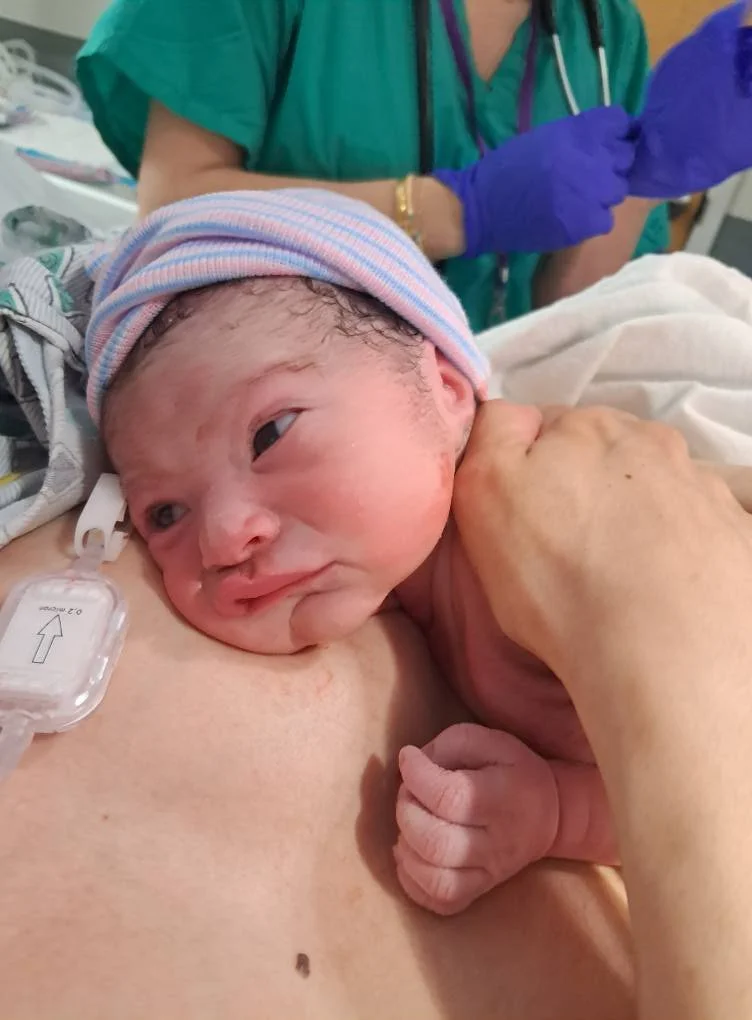
First was the midwife who, as I said, inspired that trust for me to say, Yes, I am being admitted to the hospital. And I saw, interestingly enough, I saw in her features of one of my best friends. So I almost yeah, one of my best friends, her name is Mara. I almost felt like Mara was talking to me through that midwife. And her features, the way she, the way she makes her hair, the way she speaks, her intonation, her skin color, everything was so similar to Mara. And I said, Oh, this is a sign. Again, the power of narrative. Right now, you create your own narrative, and hopefully it is one that helps you move forward. So in that moment I saw Mara and I said, Yeah, I'm gonna take this as a sign. Like my best friend is talking to me through the midwife whom I trust. I went with that. And then when I was admitted to the hospital, before they placed the balloon, there was a nurse in the room who had such a sense of humor and who had a way of walking who, you know, that reminded me of another close friend of mine. Actually, a former boyfriend from years ago who nowadays is a really good friend of mine. His name is Ida. And that same sense of humor, that same intonation of the voice, also, like the way she would talk and the way she would make jokes every now and then. Like the way she would just use her sense of humor in subtle ways reminded me of Ida. And I felt, oh, then that's there's that. There's another special friend of mine who is present in the room through another professional who's in the room with me. Okay. Then my husband was, of course, in the room, and my mother who came from Colombia, and they all were like present with me, following my decisions. The woman is in charge of making decisions. We are orchestrating this, we're the leader of the orchestra at that moment, and everybody else follows us. At least that is the experience that I was able to have at NYUNangon. That's why I highly recommend them because they respected to their best ability my birth preferences. They respected, acknowledged my birth preferences, and listened and asked for my permission before they would make any kind of intervention. They would communicate with me and wait for me to agree or disagree. That includes the epidural, right? So, anyways, the point is that then as soon as I was administered that medicine, the contractions began. One after the other, after the other, they didn't stop. And then uh as they were increasing, I delayed the take of the epidural because I wanted my doula Regina to be present. And Regina thought it was gonna take much longer. She thought it was gonna be oh, by the evening, forget the evening. She hardly had any sleep. She had to come to the hospital, and she ended up arriving like at 7 a.m. or something. The minute she arrived, I said, okay, Regina, so I think now I feel confident to take the epidural like a lower dose. And because she said, Don't wait, had to say, don't take it too soon and don't take a half dose. Don't take such a high dose for the epidural. If you can, delay taking it and take a lower dose. And I said, sure, I will. I followed her advice, I grabbed onto her advice like a lifeline. Because in those moments, you need that trust, you need those bonds of trust. I chose to trust her that way. I chose to trust the midwife. I chose to trust the nurse, and I chose to trust the people who came after. So the minute I had the epidural, still, I felt like I was feeling every single contraction. I felt like I was still feeling everything. I'm like, okay. Anyways. And then later in the process, as I was like juxtaposing extreme exhaustion with the pain of the contractions. So in the little breaks between contractions, I almost would be falling asleep. And that's such a strange combination of being in pain and falling asleep. Being in pain, falling asleep, that's not usual. So that brought me that combination brought me into a liminal space as if you were. In a dream, in a dark forest, or in the dark ocean as you're navigating. One of these resources that you shared with us, which was the most crucial of all resources, the book Transformed by Birth. Oh my god, Lisa, for the rest of my life, I will thank you for suggesting that book. Because that's when she says Artemis and the Dark Lands, and she is all of nature. She's an animal. Yeah, she is unpredictable. Unpredictability, the untamed, yes, not Apollonian, not rational. No, you become the animal. And it's kind of the journey of Persephone, also, like through the underworld. That is really how I felt, quite honestly. Or the myth of Inanna, remember? How she really goes to the underworld. So much changes in her, and she leaves everything behind gradually, part after part of herself. She's leaving everything behind just to find that she is becoming the process, and that's who she is in that moment. She's becoming that wave. I used that. I thought when the contractions were high, high, high, I said, I am this wave. I'm going down, down, down, down. As the wave was going up, up, up, up. I kept repeating, I'm going down, down, down, down, down, so that I could go surf with it. So that I could endure it and basically survive it or live it as intense as it was. I became that wave. And that idea of becoming each wave came from that book, becoming the process. So as I was in the middle of that process, then I saw two more familiar faces. One familiar face and one new face. That familiar face is another midwife who is, yeah, I believe she is a midwife and she's wonderful. She's Colombian herself, so she speaks Spanish. And then I felt, oh, my country is here. My native language is here. So I spoke with her in Spanish. When I saw her, I honestly cried of happiness. And I told her, I am so happy to see you. Because that's how vulnerable you are in that moment, that's how open you are, that's how receptive you are, like you are treasuring every little moment, every little nuance because you feel like you are in that liminal space between life and death, quite honestly. And yes, true, because your former identity will die and your new identity will be born. And in that liminal space I saw her and I really cried. I said, In Spanish, I mean I'm so happy to see you right now. And she was exceptionally kind and I felt like she was like a family member, of course. My mom in the moment she was still sick, she had her mask on because she also caught the cold, she got the flu, but she was getting better, and at the same time she was present and all she had to do was dance with me when I danced to cope with the when I danced to cope with with the contractions when I would move from side to side, like waving. I would place a hand on my mother's shoulder and then another hand on my husband's shoulder and Christian's shoulder, and I would just move with them. I would vocalize with them. I would be vocalizing and holding on to them, and they would just be present. My mom, I told her you don't have to do anything, just you being in the space, that's all. That's all for me. That's all. And then another, I believe she's an obstetrician whom I didn't know. She came, I didn't know her. Her name is Paulina. And again, her accent, her way of talking, her gesticulation reminded me of yet another friend of Francesco, another close friend of mine, an Italian dancer. And I felt like I am completely surrounded by people I love. People who are in the room, my husband and my mom, Consuelo, and people in my life who are speaking to me through the birth professionals who are in the room. And then of course Regina with her radiance and the way she would guide me as far as the comfort measures, taking the different poses for the contractions, you like being on all fours and she helps with the rebozo. Remember that? Like exactly with the scarf helping or pressing onto my hips. Yes, those comfort measures, like Regina was an expert. So she really helped. In the breaks between contractions, I would choose to sing a song, and it's still to this day when I hear that specific song, I cry because I remember exactly which song, which bachata song I was listening to. I was singing to that. Because then so much vocalization that I used, it really opened my vocal apparatus. And of course, there is a connection between your vocal cords and your uterus. So I used that, I used that vocalization more than I imagined I would. And then singing just came natural, vocalization came natural because I was helping the whole system to open. And then in the breaks, I told my mom, bring the book that we're reading. Let's read a little bit. Let me have this a little bit of a distraction. And then I remember telling Regina, I don't want to have more contractions. I can please not have more contractions. And that's the moment when I cried, and I remember that crying is a good sign because it means that the birthday is near. So I allowed myself to cry and I told Regina, at some point later on, can we go for a coffee as normal people? I was just trying to picture the moment when I could go out again for coffee with Regina. And then by that moment, all the contractions would be over and behind me. Anyway, so I was using everything I could, all the imagery that I could. I was bonding actively to the people so that I could cope. And then by the time the pushing stage came, I was not in pain, Lisa. At that moment, I was so fully awake. The sun was coming in, so it was symbolic in a way. Yeah, you made it through the underworld. Now that light is on the other side of the tunnel. And I saw that light, and all of them, everybody came into the room. Obs, nurses, midwives, all of them, the whole team came to just encourage the birth and assist me in every way they could, direct me, coach me in the pushing. And I said, I'm a dancer, I'm coached, I know what it is to follow instructions, so I can be that person of receiving an instruction and putting it into practice. So tell me what to do, I'll do it. Yeah, you have to do this. Hold your breath, push. Yeah, sure. Lisa said that it's better not to hold your breath, but it's okay. I'm just gonna go with the coaching right now. Do whatever works. Anything that works, and then it went. Then in that moment, I was not in pain. That's when the epidural really helped me not to be in pain. It was 12 minutes of pushing, only 12. And then yeah, Regina was like an eye.
Lisa: 01:13:27
And you have some good abs too.
Elisa: 01:13:30
So Regina couldn't believe it, and actually the people couldn't believe it for her first birth. And then I pictured my baby coming out. They said, Oh, she's having a little bit of a hard time coming out. We might have to use the force. I said, I looked at Regina. Regina said, It's okay, we're gonna help her afterwards if need be. I said, sure, it's fine. They ended up not needing those, not needing the force-ups. I pictured her, she's coming out. She, yeah, this is happening. No fear, no yes, pain throughout. Listen, throughout the labor, yes, pain with a purpose, as the book says, but no doubt, no fear. The two things I didn't feel doubt or fear. I didn't doubt, and I was not afraid. I was in pain, yes. So when I picture her coming out, at some point one of the OBs, the OB in charge, uh, helped her and helped her to come out, and the minute she comes out, that was such a relief. She's placed on my chest, and that's the moment when I see I feel like I'm not sure whether this is a dream or this is real. And it took me a while to actually come to the realization of this being real. Yeah. No longer an abstract idea of something that will be one day, something that is coming, something that eventually will be. No, this is now. This is real now. And this is for you. Is it really for me? Is this really happening? Is this not a dream? Is this meant to be? Is it for real? Can you even believe it? It is so extremely real. You just went through labor, but you are not mentally quite landing on the idea that yes, this is real.
Lisa: 01:15:19
Yeah, because labor puts us into a bit of, we call it labor land. I'll say today, I'll say a dream state, but activates these delta waves, these deep sleep waves. So it makes sense that we're in such an altered state of being and consciousness that it can make it feel all the more surreal in many cases. You just said it. You just said it. I have a question on the forceps. Usually talks of using tools like that don't come up until we've been pushing for a long time, but you just said you pushed for like hardly any time at all. Do you know why? Any idea why they brought that up?
Elisa: 01:15:57
They said it looks like she's having trouble coming out.
Lisa: 01:16:01
But after two minutes? What?
Elisa: 01:16:04
Yeah, 12 minutes. Like I said, listen, I didn't argue. I didn't argue in that moment. I just looked at Regina and she gave me confidence with just her look. And I said, sure, if need be, that's fine. I didn't argue. I said if it's necessary, then it's necessary. But then I was committed to continuing with the coaching. Yeah, and I was fully, I felt like I was fully in charge of that pushing. I felt I am in charge. I'm not in pain right now. I'm doing this, so tell me what to do and I'll do it. Should I do it again? Ready? Is it okay to do it again? I was so ready to be coached in that moment, and it worked for me in that moment to be coached. And the thing is that when they said about the forceps, I felt my baby. I was, as I said, paying attention to everything that was happening to my body, we were listening with such accuracy. I felt her head coming out and in, out and in, as you taught us that would be the case. I, yeah, I was making the room for her, making the room, yeah. Allowing the back and forth movement to take place. So I felt, I really don't know. I don't perceive in my body that she's having a hard time. But sure, if you need to use any extra help, sure. But maybe that came from a place of confidence. I know she's making her way, and I know she will make it out. So yeah, I wonder why they rushed to that idea of possibly using the forceps. But very odd. It's very odd. And then they were helping me with the opening of the cervix, right? They remember the whole ring of fire and the thinning of the cervix. They were really helping me with that, trying to open the way for her. And she came out really not long after I started pushing. So that's the force of that's actually such a good question. Why would you even rush to that idea?
Lisa: 01:18:14
It's usually hours before they start talking about that. But maybe there's something I'm just not that's not occurring to me right now but it's odd. It's very odd. No, I'm glad you didn't need them. You showed them. No, I don't need these.
Elisa: 01:18:27
I actually don't need them. And I, yeah, what was challenging for her in that moment, quite honestly. They were concerned at times they would lose if for moments they would lose the heart rate of the baby. The constant track of the heart. So every now and then they would lose the heart rate before it would come back. So they would immediately be concerned about that. Okay. Maybe it was just coming from that place. But physically, as far as my physical sensation, she was like just making her way out. She just needed that extra, she just needed the time to make it happen. And I didn't sense any kind. Yeah, I didn't sense any kind of obstacle. But as I said, I was in that moment, I was trusting and allowing. Allowing. Allowing the in in that moment, I was allowing for the best advice to take place. And yeah, if that came to be something necessary, I would not be opposed to that. But yeah, but then yeah, lo and behold, it was not necessary.
Lisa: 01:19:33
Nice. All right. So then going into afterbirth, any things that you want to highlight in the hours, the days, or the weeks or the months that have passed since you gave birth.
Elisa: 01:19:47
Yeah, yeah. Giving yourself the time to heal properly is very important. I am somebody who believes in movement in any way that it can happen. Of course, prior to birth, you're using opening, flexibility, gravity. After birth, you're using the opposite. You're using the compact, the compactness of verticality to engage your core, even just sitting down or standing. Engage your core so that you can help and support everything to come back to center. You're not using gravity in postpartum. Gravity is not your friend or any flexibility that's not your friend. You need to stay compact and allow the body to close. After such an opening, the wound needs to close. So yeah, it was basically recovery comes in different stages, and in a way, like feeling that I had a two-centimeter natural tear. They didn't do an episiotomy, but I had a natural tear of two centimeters. So of course I needed some stitching, yes, and that needs to heal. So that the healing of that it takes some time and you feel it in your pelvic floor. It pounds like it, you feel it more pronounced at certain times in the day, maybe after you have been standing for too long. Your pelvic floor right away speaks to you and tells you you need to relax right now. You need to stop doing what you're doing and just lie down or sit down, just relax. Now, like your pelvic floor tells you, right? Then that's one layer of recovery. Another layer of recovery was the sciatica. I was still feeling the sci the pain, yeah, the sciatica pain. And of course, that takes time to completely go away as your body reconstructs itself in its pre-pregnancy form. And then also you want to add the breastfeeding journey. Like, of course, when you get started, that hurts, and then you have just like different areas that are healing in your body, and how you're able to tend to all of them and use the new objects that help you heal. The sits bath that you told us about, all of that. You need the logistics. You're implementing logistics that you didn't use before pregnancy, and that also takes some adaptation. Breastfeeding, like taking care of your skin so that the nipples stay strong in that journey of starting to breastfeed, especially the first days at a hospital when the baby begins. It could be very challenging to just endure the discomfort and you learn, your baby learns for the proper latching, right? And for the proper latching eventually will be pain-free. But it does not begin pain-free. It begins in a way that is like a learning process. And so your breasts are sore, your pelvic floor is sore. You are gradually finding your core again, you're shifting the way you go about your body from a complete openness to helping it close. You cannot carry anything heavy, you cannot walk for too long. Hopefully you can lie down for as long as you can, but at the same time, you're gonna breastfeed, you have to wake up and sit down and get up and do things because you're taking care of the baby. For me, a major paradox is the fact that the mother is healing, but she's essential in taking care of the baby, and you don't sleep, obviously, your sleep patterns are completely upside down. And how are you supposed to heal when you are in demand for the care of the baby and when your sleep is fragmented? How are you supposed to heal? So you need to heal, but you are needed in caring for somebody else. That's why I think it is absolutely tricky but essential to have your support system, like your partner. In my case, my mom was, I mean, she was an absolute mentor. In helping me review all the materials that you shared, and that was like a master study session before giving birth. But then also she would help with nutrition, she would help with making sure I was taking care of myself, I was like keeping warm, I was drinking enough water. Like she was being my mom. She was taking care of her baby, which is me from her daughter, while I was learning to take care of my baby. So the presence of my mom and the fact that she would help us every other night in taking care of the baby, so we would like to switch nights. So she would take care of the baby one night, and then we would take care of the baby the next night. So we would sleep every other night. That truly was tremendously helpful. I feel like that's the reason why I was able to heal. Also, about breastfeeding, my baby, she eats a lot. She eats a lot, she eats a lot, a lot. So we combined, we breastfeed and I also gave her an Australian formula, goat milk based that Regina recommended because it's better for digestion. So that combination ended up initially I wanted to breastfeed exclusively, but because her demand is that high, uh, I ended up saying that yeah, it's better to supplement her. And that also became a blessing because that allowed me the flexibility to say, okay, mom, so tonight you can take care of her and we can sleep and heal. And then for the next night, I'm there. So that finding somebody who can help you support you to sleep in postpartum, there's nothing more crucial than that. Nothing more crucial than that. Truly. Absolutely. For you, for your body to start healing. How long was she able to be with you? She was here. That is something very Colombian. We are like families and we were very supportive of each other when it comes to families. So she was here for two months and a half. Amazing. Oh two months and a half. Oh that was incredible.
Lisa: 01:26:30
So just very recently left.
Elisa: 01:26:33
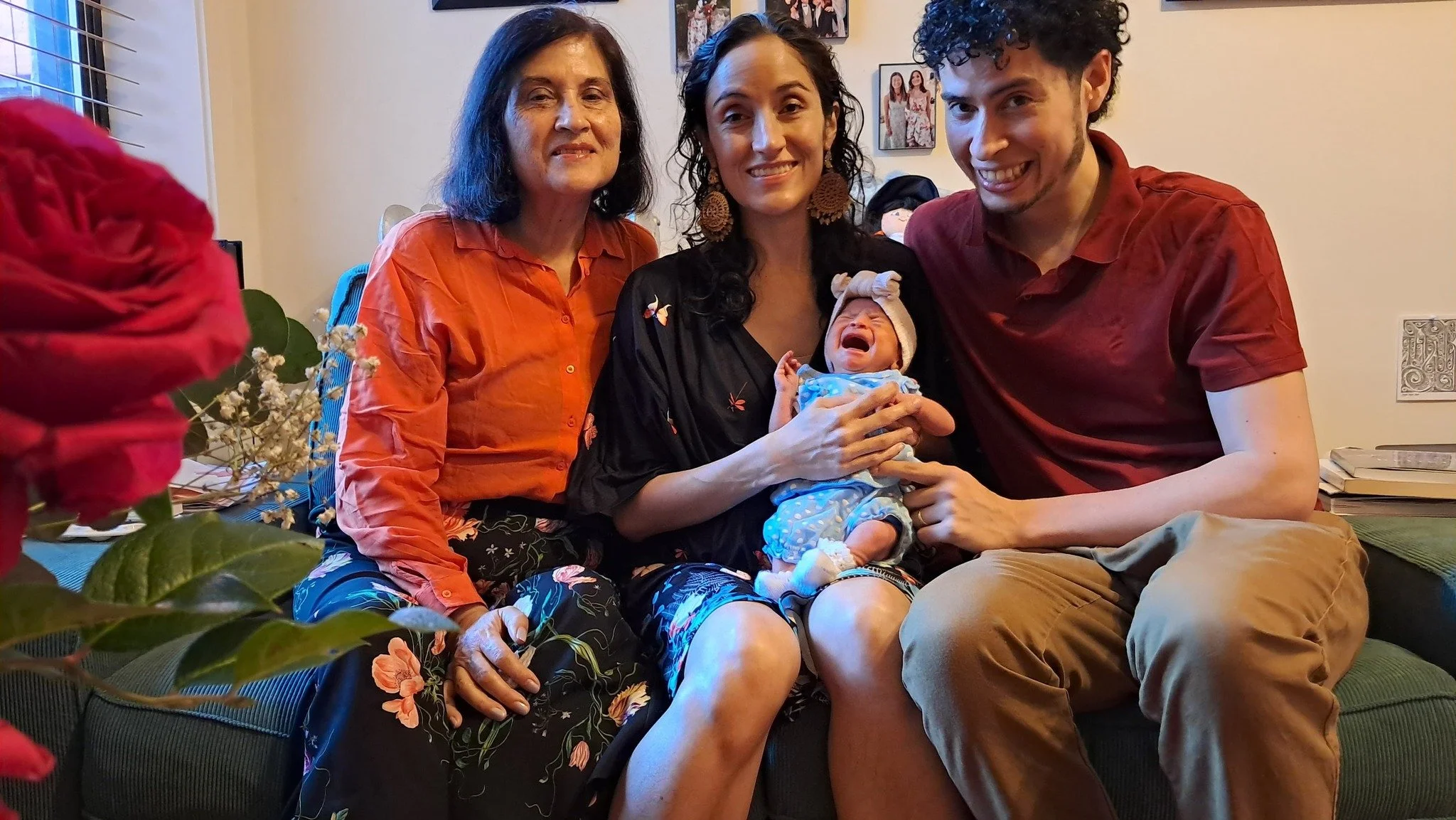
She left at the end of April. She left at the end of April and she also with her ancestral wisdom, she would help us, help Christian and I, my husband and I, to realize so many things. The importance of taking exposure, like placing the baby in um placing the baby in such a way that she can receive some sunlight, or start building some routines for her, or helping her exercise, move her legs, things like that. Or start reading to her, start reading as early as you want, even way before they can understand language. Like things, so many different things, helping supporting her so that she can make the difference between day and night, and then at night, keeping it as simple so that she can realize that she should continue to sleep because it's still dark, that things like that, that my mom is like it can only come from an experienced mother building routines, for example.
Lisa: 01:27:37
So glad that you had that support. That's wonderful. It was life-saving.
Elisa: 01:27:44
It was life-saving.
Lisa: 01:27:46
And are you going to be raising Luna bilingually?
Elisa: 01:27:52
At home, she will hear me say only Spanish. Like for Christian and I are absolute firm advocates of the Spanish language. Beautiful. So we are adamant when it comes to we will speak to her in Spanish inclusively so that she can cultivate Spanish. Why? Because she will be learning English almost by osmosis. Yeah, like she she naturally will learn English. Yes, in school, everywhere, everywhere she will be she will be listening to English and learning English. The question is if she will be able to learn her native tongue and actually preserve it and make it a natural source of wisdom for her. So many kids who are the kids of Latin American parents are raised speaking English. They hardly speak Spanish. They are Latin American, but they don't speak Spanish. And I feel like that's a tremendous loss, cultural loss. I agree. We're not participating in it. We are gonna preserve the Spanish and take her to Colombia and bring her to Colombia for the family to meet her and all of that. And of course, the bilingualism will come naturally, but for us, Spanish is our treasure.
Lisa: 01:29:13
And I know you mentioned speaking to I think it was a nurse, a Colombian nurse in Spanish. But did a lot of people in labor just automatically go to their native tongue, their first language? Did you find that in other times in labor you were doing that? And your husband also speaks, obviously, and your mother too, so it would make a lot of sense. But I was just curious about that.
Elisa: 01:29:37
Oh no, for me, I've been living in New York for so long. So like bilingualism for me is now you go back and forth between Spanish and English, depending on the occasion. So for me, uh as I was coping, like the vocalization had no language. When you produce sounds that are lower in frequency and that you're vocalizing to help you cope with the contractions, those were like those were not phrases, those were sounds. But yeah, but uh as you said, like having my husband and my mom there, plus the midwife who speaks Spanish, those were my opportunities to tune into my native language. But then when it comes to speaking in English or deciding yes or no on the epidural, it becomes natural to me. But yes, like having yeah, it was absolutely precious to just have my mom and my husband and also the midwife who is from Colombia, to have her in the room so that I could just connect to my language in those moments.
Lisa: 01:30:38
That's so much. Oh, and I could just talk all day, but we're gonna have to start wrapping things up, unfortunately. Would there be any final themes or words of wisdom that you would like to leave our listeners with who are mostly expectant parents?
Elisa: 01:30:54
Yes, I feel like courage is an important word. It's a profound word of wisdom. Intuition, the wisdom of the body, trusting your intuition, listening to what your body tells you, and hopefully not second guessing it. Becoming the process and becoming the wave, each wave, being present in each wave. I think those are like cornerstones of wisdom when it comes to this. It was for me, navigating the process of birth. And also Yeah, like tuning into dance in any way that could be true of anybody. Everybody's different, everybody functions differently, you would have some movement tendencies that are different than somebody else, yeah. But whatever your movement tendencies are, I highly recommend going for that movement in pregnancy as much as you can. And as soon as in postpartum it is safe to do so for everybody, again, that could be different. Go into the movement because movement helps you bring everything into a coherent state. I feel like I am happy to embark on a journey of sharing some of my dance wisdom with women who are going through this journey. Because for me, it was like pivotal, like it was absolutely crucial for me to stay active, to stay moving, and to stay dancing, so that I could have a pregnancy with little to no modification of my regular activities to do of my overall life as a dancer, and then to have a like a speedy recovery after birth, truly. So those are our words that I would really share with expectant parents.
Lisa: 01:33:02
Oh, this has been a treasured time. Thank you, Elisa. You again are just so inspiring that you have such a beautiful, mindful way of wording things and in yeah, just a very different, inspiring way. So I appreciate you, and it's an honor to know you.
Elisa: 01:33:22
Oh my gosh, Lisa, I am so grateful to you. And also, one last thing is the open-mindedness that we were talking about earlier. Open-mindedness, because as you taught us, and as we heard in that audiobook, there's not one way. Like birth can come, it will come differently to everybody. So, like being available, present for that to happen, like being available for that to take you. You know, that was a crucial moment of wisdom in the process of labor, and that came from the Colombian midwife. Let it happen to you, let it take you over. Don't resist, don't think that you are controlling it. Surrender to it because that is where your transformation of identity is happening. That's where it happens when you don't resist it. So that also goes hand in hand with being open-minded, right? And just giving yourself to it. And in that moment, you did enough preparation. Sure, now the performance time is the performance time. Let it go. Trust and bring yourself to dive in. So for me, it's an honor to see you again, Lisa, to share all of this with you. All of this, truly, I am so grateful to you. I feel like I will be forever grateful for all the tools that you shared with us. I would recommend anybody to take your birth matters, birth preparation course. I cannot even think of any other place where I would go if I were preparing to give birth. So you are the one I think I express my gratitude to because you just made a tremendous difference in us being able to bring Luna into the world. So thank you.
Lisa: 01:35:08
Thanks again to Elisa for sharing that beautiful story. Since we recorded this, I'm happy to report that I finally had the privilege of seeing Elisa in a dance performance in downtown Manhattan, and it was so beautiful. And I also got to see her husband, Christian, and baby Luna too. What a treat. And I hope that I get to see many more of her performances. Okay, last thing is a little sneak peek of what's up next time. And I'm very excited because this will be our very first twins birth story.
Jillian: 01:35:41
Very shocked by the news that it was twins. The provider actually said to my husband, I've never seen a partner so flustered by this news. And she offered him water and was just like, Do you need to sit down? Because we were surprised. Fraternal twins are hereditary, but there's no history of them in my family, and it usually runs on the maternal line. Again, no history that we're aware of. So we did not have it on our radar at all. It's not like a lot of folks were hoping for twins. So it was just shocking and exciting, and we still can't believe it, honestly, staring at two tiny babies. It breaks the brain slightly.
Lisa: 01:36:18
Today you heard Elisa share how dancers are accurate listeners of the body. Now, everyone has a different relationship with their body, and of course it can be complicated. But something to ponder today might be along the lines of what is my relationship with my body? How can I be an accurate listener of my body in this time in life? But also, maybe how can I be gentle, tender with myself and my body? Thanks so much for listening to the Birth Matters podcast. If you enjoyed this, please be sure to follow or subscribe, maybe leave a review if you can, and to share with a friend. Have a good one, and until next time, be well.